Posts

Showing posts with the label Organizational

Using "No Off Ramp" Decisions as Forcing Functions for Driving Change
Image
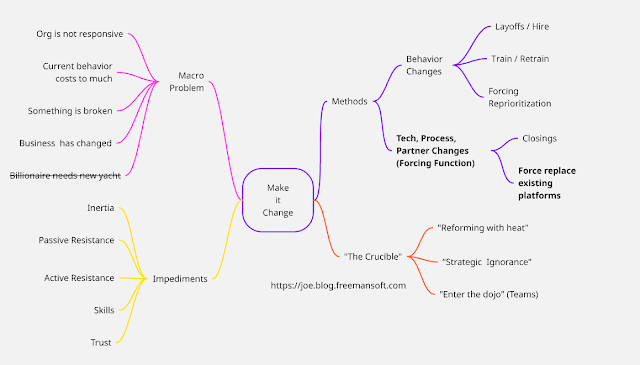
Sometimes we need to have a forcing function to make change inevitable.  Implement a no-off-ramp change that aligns teams and partners with the vision.  This assumes you have enough clout or leverage to make that happen.  Drivers can include asset sales, contract changes, and regulatory issues. Holding the line can be challenging when people raise issues and either actively or passively resist.  Make a type of change that cannot be reasonably undone, and then create gatekeepers for the new desired behavior when people are onboarded A Mind Map Thinking through the aspects related to making changes. See the video down below for a better explanation of the diagram than I do here in writing. Click to expand Maybe I can get an AI to convert the transcript into the body of this article. Problem You have a problem that can't be resolved as a normal part of the business. The Organization refuses to respond to the need.  There is some current behavior that is driving up ...
The Crucible - Melting the status quo with targeted strategic ignorance

Image
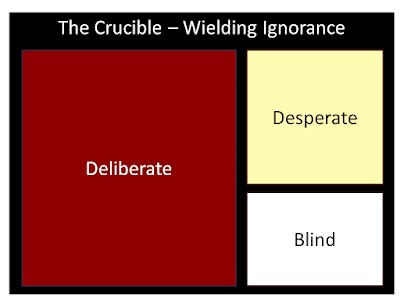
Executives have several tools that can re-forge an organization from the top.  They can reorganize changing the boundaries created by Conway's law.  New executives can push out embedded interests and bring people in from the outside. They can brutally question everything through targeted ignorance.  A main tactic is to hire senior people with no knowledge of internal complexities or implementations. They come in questioning everyone and everything with an assumption that the hard stuff exists because of complacency or because people are locked it was always done that way. New people propose or demand refutation of approaches in past lives or other industries or with previous engagements.  The legacy organization's natural reaction is that the new ideas won't work and defend the status quo.  New people apply additional heat declaring that the status quo won't stand often replacing people who stand in the way. This applies indirect heat to the rest of the organiza...

Ask - Propose - Ask Why Not - Repeat - When new to a role

Image
You've just joined an org as an employee or a contractor and you want to contribute now. You have to contribute now to validate being there. now. This can lead to the urge to start spewing solutions based on your previous experience or what you saw others do somewhere successful.  Famous billionaires can force their will to what they want. The rest of us are best served by asking questions, asking the right questions, learning the language of the domain, and building credibility inside the organization. Then you have to differentiate the real from the imagined and drive towards improvement wall iteratively asking questions, proposing solutions, and teasing out the real from the imagined in the responses. I'm not saying to wait until you know everything until you contribute. Instead, work on two paths.  The one where you can make contributions now and the one where you increase your credibility, create relationships, and become deep enough to have an impact. I...

Programmers' Credo: "We do these things not because they are easy...

Image
Yet another tool in our understimation arsenal. We do these things not because they are easy, but because we  thought  they were going to be easy. This applies to more than programming.  I'm looking at you, my most recent repair project. Credit goes to Jeff Atwood  around 2016 Revision History 2023 11

The Crucible - Heating up teams with an agile coding dojo.

Image
An Agile coding dojo is a technique that can be used to create high-pressure software development situations at the team or project.  That pressure exposes weaknesses and forces change and adaptations in short iterations. The idea is to change the game and accelerate the lifecycle to force behavioral change. It is a crucible where you either learn to deal with transparency and change your model or you fail.  A coding dojo is a local optimization. The crucible operates at the team or set of teams level. It creates individual team cohesion and learning. It keeps the overall organization the same. It can only be the crucible for organizational change if more strategic and systemic re-forging is done above the effort. I was once involved in a 6-week Agile coding dojo where we compressed our standard 2-week iterations into 2.5-day iterations. All the work of a Scrum-style sprint in 2.5 days. Teams had to break down their work into smaller chunks and become fast at estimating, plan...

The Crucible - Reforming an organization with heat

Image
A  crucible  is where you melt down your existing metal and add new metals to create and cast a different alloy that fits the current need. This is often the only way to reshape an organization for the future. Major changes driven by external forces require dramatic adjustments outside the standard processes in order to drive change at a faster pace.  Corporations and groups are like an alloy comprised of the company's stated culture, its actual culture, and the attitudes and beliefs of the people who work for it.  The initial cast defines how a company operates and determines how it succeeds or fails. Big changes require attacking that historic casting. Mature organizations struggle with deep change because they have hardened around policies and behavior that are broadly executed but may not be well understood. There is strength in this as it can resist or overcome transient business, regulatory, or economic issues. That strength is a weakness that makes it difficul...

Meetings without Agenda and Background Must Die

Image
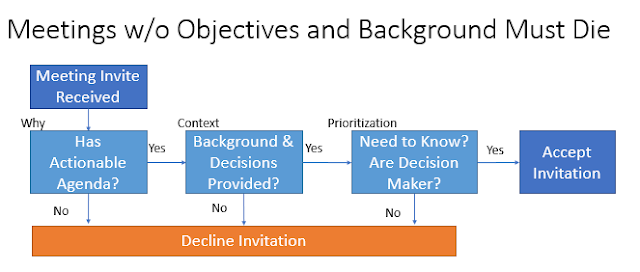
Meetings can be crazy expensive and demoralizing when they burn hours without generating results.  Good design sessions, decision-making sessions problem-solving sessions start with the pre-meeting work.  An empty meeting invitation is useless and a time drain. Invitees should decline them. A meeting without any context about the problem or prior decisions is going to fail or be way more expensive than it needs to be. Invitees should decline them. Invitations should always state the purpose, contain an agenda, describe the expected decisions that need to be made, and contain background content. Everyone has to do their part.  Organizers must meet some minimum bar for meetings to have any value.  Attendees must read the invitations and the background materials. There will be super secret projects  where no agenda and no supporting information are provided. Those should be the exception rather than the rule. Click to Enlarge Productive meetings have inputs, proces...

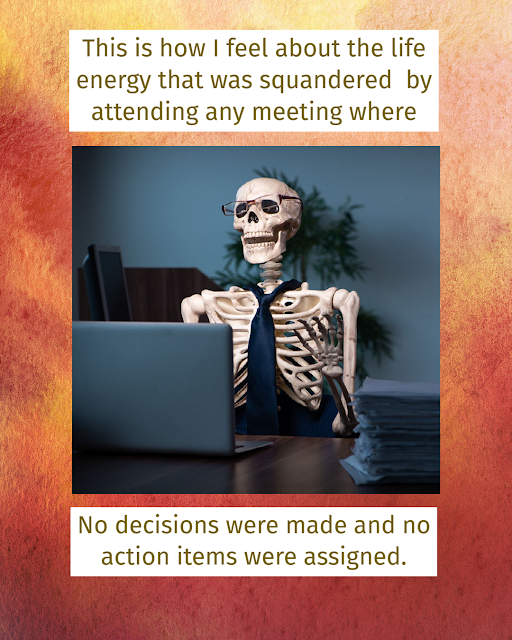
The Meeting was Pointless if there were No Decisions Captured and No Action Items Generated and Assigned

Image
Meetings are useless if those attending don't understand the outcome and if the decisions made and additional action items are not captured in a way that can be shared and verified. Meeting minutes or some other document must describe the decisions that are reached, open action items that are assigned, and a checklist of the original agenda items that were actually covered. YouTube Generated Transcript This Video https://youtu.be/2YakVsOT74g transcript with minor edits  I'm going to do three talks about meetings This first one is about making sure that somebody actually knows why they're having a meeting and they've explained it to people and provided the information that was required to run that meeting.  The second one's like how to run a meeting correctly. That is the one I struggle with the most. I'm not going to cover that one yet. The third one is capturing the outcome of a meeting. How do we know if it was worthwhile? I got to tell you I have been in I a...

Does using SAFe mean you recognize that evolution is the best your bureaucracy can hope for?

Image
I'm wondering after watching SAFe after 3 organizations... Is SAFe designed for transformation or is it evolution in transformational clothing? SAFe claims to be transformationally agile but it makes sure to click all the check boxes for a large organization. It seems structured to enable buy-in.  Who is the target audience for SAFe? Is SAFe designed for bureaucracies that want to evolve knowing that transformation is beyond their reach? Many organizations can only transform in a crisis.  Transformation is unlikely when people talk about adapting the approach to the org more than they talk about changing the org to the approach. SAFe has a lot of pieces so "adaptation" discussions happen immediately attenuating the transformation. It feels like the bulk of the SAFe adopters are large companies or government agencies. Small companies or big tech build their own culture and processes tuned to tech and seem to rarely use SAFe or other big agile. Transformations take years....

Companies can punish those that buy in to transformation

Image
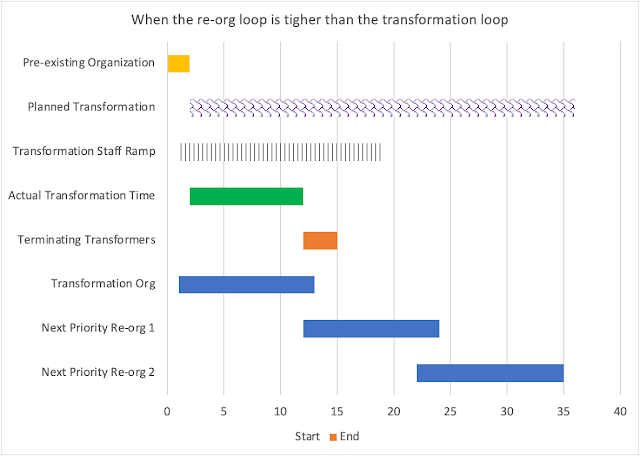
Companies can accidentally teach people that being "all in" on transformative efforts is risky and potentially career-limiting (CLM).  They do this because joining a transformation or reshaping puts those same people on the "most likely to get laid off" list when the company's senior leadership changes direction. This behavior flips the risk-reward decision process by rewarding those that keep their heads down and those that "wait out" any changes.  Passive resistance or inaction is more profitable than commitment. Transformation initiatives spin up when companies recognize the need to change. They organize around the transformation as a top priority. This continues until the next prioritization cycle with its associated reorganization. The previous priorities including the transformation are de-prioritized. This de-prioritizes skills learned to support the transformation. Companies ramp up to transform and then ramp down those teams punishing those t...

We are not here to drain the pool - Companies smother the culture they purchase.

Image
Large companies purchase smaller ones to enter new markets, buy IP or get an edge that they couldn't otherwise make happen.  It is crazy but then they often integrate  those acquisitions into themselves often killing the creative spark and culture that made that acquisition important, to begin with. Does anyone know of a company that succeeds with acquisitions without smothering the culture that they purchase?   ROLM and the pool metaphor that wasn't a metaphor IBM acquired ROLM in the mid-80s. ROLM was a market leader at that time and one of the companies that prided itself as a Great Place to Work (GPW). ROLM created a place with a completely different culture from that of IBM.  There was a story that IBM showed up to the first all-hands meeting with the employees and said  We are not here to drain the swimming pool. IBM then went on to do everything they could to make ROLM conform essentially draining the pool that didn't fit their model. IBM moved its p...

RTO and a return to office hostility and micro-aggressions

Image
The office is a hostile environment for a lot of people especially if they don't totally fall into the majority behaviors, culture, appearance, or stereotypes. The Work From Home (WFH) shift, during the pandemic, made these people's lives better.  Post-pandemic management is calling for a Return to Office (RTO) to  foster corporate culture and accidental communication .  Return to Office  is sending people back to a place where their work is often less important than other factors more subjective factors.  Some communication is strongly negative and unwanted.  Executives and old line managers are pushing for  Return to Office (RTO).  They rightly call out the advantages of accidental communication and the higher bandwidth decision-making.  I suspect that we will find that the biggest advocates are older, lighter, and more male than those asking for more flexible working relationships. The people calling for RTO either don't understand the si...

Organizational response to transformation - white blood cells swarming to stop an infection

Image
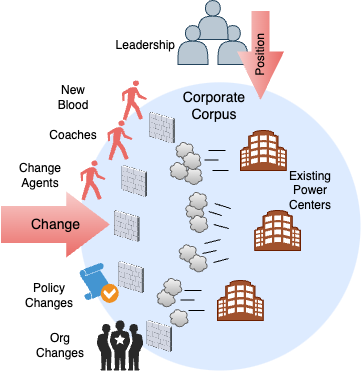
Transformation is hard and people only tend to do it when a situation is untenable or the evidence undeniable.  You have to be willing to break things when you transform and it is often hard to stand up to the scrutiny of doing it prior to some major problem. A retired executive and I were talking the other day. I told them about two places that rolled back their transformation efforts after a regime change where the transformation champions left or were reorganized out of that role. The exec said that we were in the phase where seeing: The white blood cells were swarming the transformation infection to eradicate it. This article exists so that I wouldn't lose the quote for this Larry-ism . 👀 and this one from JK  The strong biological reaction to change feels like a  corporate autoimmune disorder. I love that phrasing.  It provides a good analogy for the corporate corpus reaction to forced change after the initial ...

My first 4 projects were complete failures. The next 4 were complete successes. I thought it was all me.

Image
Failure and Success. Was it me? Experiencing success and failure. The common denominator was me but maybe not the common cause. My first 4 were failures.   I thought I was the common denominator I need to change industries The next 4 were successes  I thought the common denominator was me I needed to go on stage and talk about my awesomeness The next 4 were a mixed bag.   I grew more discerning about when something would succeed or fail, usually because of political issues or snap-back. I could help make it happen but wasn't in a position to do it by myself. So I just had to continue getting better. Repeating success was hard It depended on the org. The same people might not succeed in a different setting or with a different environment. The organizational appetite for change and success is the top-level function determining success. You need to improve to contribute and tilt the playing field in your favor. Revision History 2023 03 Created

"I'm here to get paid" may reduce your value and limit your future.

Image
We are all "here to get paid" but you are shortchanging yourself if that is the end of your thought pattern.  This is especially true for those in the knowledge industry.  None of us would "work here for free" but knowledge work isn't static. It evolves over time and provides a growth path for more money and stimulation. There are times when you have the opportunity to move to the next level in your skills and the respect of others. Exploit those opportunities. Those skills and respect can lead to better work with more skills and more respect. More respect means a bigger social network.   Bigger social networks can lead to more interesting work and more money.  A high percentage of my work came from former co-workers. Work is the thing that lets you support yourself and your loved ones and provide leverage for a better future. Extra  investments at the right times can result in higher lifet...

The Power Law Curve and People Performance - The few outperforming the many

Image
People claim that great software engineers are 10x as productive as the average engineer. This notion has driven the industry transformation efforts for decades. Agile and other efforts are all about enabling high-performing teams. Studies show that performance follows the power law curve and not the bell curve. This radically changes the way we think about above and below average. I have another talk that discusses layoffs and IP that felt incomplete because it didn't address the phases that lead to layoffs. The reality is that some significant percentage of people or programs do not materially contribute to the company's success. I worked at a home lender where I was convinced that the department could shut down for a month without materially impacting the business. This eventually leads to layoffs.   Video The 60 second short version Images used in the talk Speaker's Notes to Follow Speaker's Notes to Follow Speaker's Notes to Follow Speaker's ...