Posts

Showing posts with the label Soft Skills

Ordering pages in a coding challenge scrambled my preconceived notion about "natural ordering"

Image
We have a notion that there is a natural order of things.  I'm talking about ordering, and sorting, by convention as a mental aid or for product reasons.  Everyone is familiar with ordering products by weight, pieces by size, and names by alphabetical order.  We are so used to some types of ordering that it seems like the natural way when there is nothing natural about it. A common example is the "order of assembly", the order of parts installed onto the device.  The reason for the order on the direction sheet may not be immediately obvious.  The order takes into account the ease of assembly or the reliability of putting it in at that point in the cycle. This caused me to waste over an hour during a recent programming challenge while implementing an arbitrary set of ordering rules. Eventually, I realized that the notion of order is arbitrary and that I could change the standard to fit my problem space.  Let's go to the programming challenge. An example from...

You really know it only once you can teach it

Image
Teaching someone else makes clear what you really know.  You fully understand it when you can explain it to others. Teach others lays bare the wholes in your knowledge and where your assumptions were enough "to get by". Image by Adobe Revision History Created 2024 11

Telling people "silence is acceptance" when we ask for input and they never reply

Image
Everyone needs to provide input or feedback when we are spinning something up, troubleshooting something, or digging in. They should raise disagreements, tune the plan, or otherwise get involved because eventually, it will become their plan. To achieve the best results, we need to provide enough time, the appropriate venues, and the means for providing that feedback and participating in the decisions. Once provided, it is on them to speak up if they have any issues. Sometimes we have to make it explicit to get people to pay attention. "You have agreed to this path if we don't hear from you by that date. Your silence in this matter is acceptance." Opting out of the results is not an option. Video Other There may be alternative views depending on the environment but that is for another time. Silence is Acceptance Silence is Apathy Silence is Antipathy Silence is Avoidance Revision History Created 2024 11

The value of technical conferences can vary widely based on their intent and how you attend

I was recently whining to the "home budget office" about being unable to justify personally paying the entry fee for this year's re:invent. AWS evolves so quickly that I feel obsolete after being heads down for a year not running my technical radar against their continual announcements. I wanted to use the conference as an info dump to stay relevant to keep future options open. Would the information boost and brain stretching be worth the cost? The main question when thinking about attending a conference is the "information density"/"cost" ratio. Are there enough immediate takeaways to make it more than a technical vacation? The default large vendor conference attendance pattern is easy but has low information density. This attendance pattern isn't justified if it is all I do. Attending the Keynote and the large talks can all be done at home. Thousands of re:invent sized event attendees watch the Keynote remotely anyway because there isn't a...

Decoding common responses

Image
Rating system for meetings, team reviews, code reviews and, disaster war rooms. Bullshit - not true Dogshit - terrible Horseshit - nonsense Apeshit - angry Batshit - crazy The shit - the best Well Shit - disbelief Deep Shit - big trouble Additional meaning in other situations No shit - you don't say? Aint shit - deadbeat Good shit - this is awesome Most of these were pulled from an @threads thread. Revision History  Created 2024/04

Titles matter when they give you a seat at the big people's table

Image
A title acts as a credibility and conversation gate for enterprise communication and decision-making. Senior management expects to participate in meetings and make decisions with people at their level or, one below. Meaningful two-way skip-level communication is often rare. Feedback and input are filtered by the title and role of the person making the request relative to the person receiving the request. This applies across organizations as well.  "The business" often engages their counterparts at the same level effectively cutting off senior contributors.  Conway's law for Titles? The Impact of Title on Impact I'm talking about the title itself, not the job level which drives pay and rating bands. The " Director " level is the first real breakpoint for this.  Inter-org networking happens at a job title level where people attend the same events or training.  Companies often create decision-making groups, hold off-sites, and do major planning at the Director...

Building your brand - Being visibile in a cross ranking environment

Image
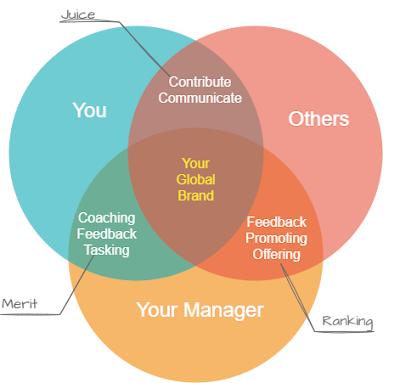
Your personal brand and reputation are the most reliable tools for succeeding and being perceived as succeeding in an organization. A lot of people rely on their nearest manager to do the heavy lifting. That can become a single point of career failure. They may move or be moved. They may not have the personality for ratings combat. A better plan is to help them help you when it comes time for new opportunities, promotions, and compensation.   Cross-group rankings are objective, in theory, but are really a cage match of discussions between management where they put everyone into a pool and rank them against each other.  This means management speaks up about their people to increase perception and question other management about their staff to create doubt about their people's relative position. The best way to come out on top of this is to have strong management and to be visible to others to create familiarity before the process.  This is especially true in envi...

Ask - Propose - Ask Why Not - Repeat - When new to a role

Image
You've just joined an org as an employee or a contractor and you want to contribute now. You have to contribute now to validate being there. now. This can lead to the urge to start spewing solutions based on your previous experience or what you saw others do somewhere successful.  Famous billionaires can force their will to what they want. The rest of us are best served by asking questions, asking the right questions, learning the language of the domain, and building credibility inside the organization. Then you have to differentiate the real from the imagined and drive towards improvement wall iteratively asking questions, proposing solutions, and teasing out the real from the imagined in the responses. I'm not saying to wait until you know everything until you contribute. Instead, work on two paths.  The one where you can make contributions now and the one where you increase your credibility, create relationships, and become deep enough to have an impact. I...

Presentation and Communications Checklist

Image
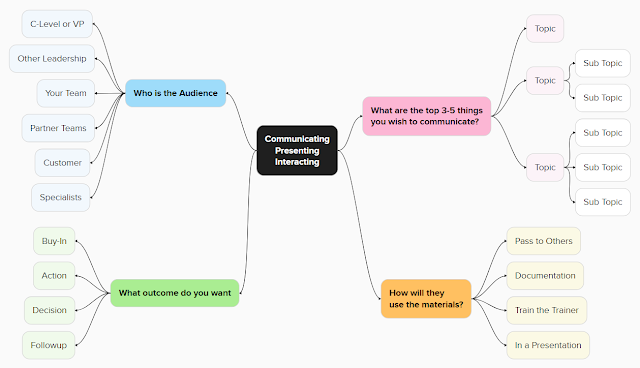
Make a checklist and review it before, during, and after creating a presentation. Here are 4 things that I have to remind myself whenever I create a presentation or information transfer content. What are the top 3 things you wish to communicate? Who is the Audience? What outcomes are you trying to achieve? How will the materials be used over time? Click to Enlarge The mindmap was created in Mural .  You may be able to see it  with this Mural link  if it hasn't yet expired. Video Partial transcript The following text is from the talk transcript and require clean up. This is really about how we're going to communicate? When we communicate with other people, we create a presentation or create some type of canned or interactive communication. What are the things we should think about? What are the kind of checklists we should have to make sure this communication is going to work the way we want? This really came out of reviewing a PowerPoint presentation. There were parts ...

Being passionate about what you do and understanding what you can really get out of it

Image
A broad range of behaviors and commitments happen when working beyond what you thought was possible, building a team with a passion, and building things bigger than yourself.  The best parts of that aren't what you build even though that is amazing. The best part is the experience gained and the relationships built with people you can't believe you get to work with. Companies don't care about individuals and will push you out the door and find someone fresher without a thought. The company lives for the company. Billionaires live to be bigger billionaires. You have to protect your mind and your health. When you inevitably leave, you will take the experience, memories, and co-workers you hope to meet in future work lives.   YouTube Version When I love every day at work I think this: "hard work" "I'm one of the lucky people who loves what they do" "creating things/work is a passion" "Working with passion is the only way" "I...

If Einstein can explain relativity then surely we can explain technical issues to product and business.

Image
We, technicians, need to at least try and communicate with our non-technical partners. I loved this Renate-ism and want to make it sticky somewhere visible everywhere I work. "If Einstein was able to explain the theory of relativity, then surely someone can give an explanation I can follow along with about a framework or technical feature" Product people are smart. It is on us if we can't get communicate the value and function of something to others!  We are not creating anything more complicated than an entirely new branch of physics. Einstein Quotes “The definition of genius is taking the complex and making it simple.” All Industries I wrote this about software engineering and product owners but it applies to all industries.  There is nothing worse than a medical doctor who uses jargon in a way that you can't tell whether or not you have a real problem. Video Revision History Published 2023 02

Surfacing things we know nothing about - What we know vs What we need to know

Image
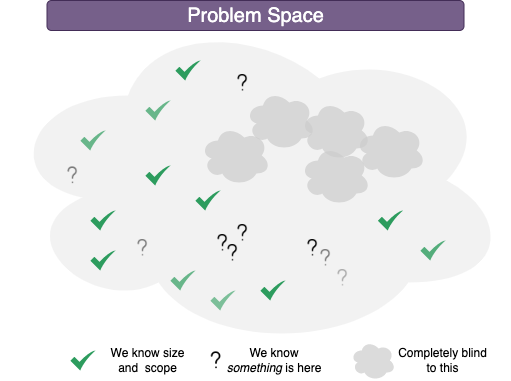
Every nontrivial problem space consists of a multitude of issues, constraints, data points, and information-driven decisions. We try and understand or manage these conditions and variables based on our risk assessments which are biased by how well they are understood.  This effort is a continual iteration where we strive to collect and classify issues and variables as we run across them.  Some of these problems are very complex or outside our sphere of experience which forces us to pull in other disciplines or people with other experiences that may be able to identify additional requirements and constraints, unknowns, and uncertainties.  This article is in a draft and is subject to revision. I first heard the known-knowns   known-unknowns  and unknown-unknowns when a technocrat gave a speech over a decade ago.  I had no idea what they were talking about and later learned it was a decision-making and political modeling tool  https://en.wikipedia.org/wik...

Urban Dictionary - training wheels for inclusion?

Slang and culture dictionaries can help us understand others without forcing them to completely code switch for all our interactions.  We don't want to remove bans on insulting or demeaning speech.  We do want to let people use their native phrasing and nuance and find the tools that bring us to their world.   The Urban Dictionary and others have a bunch of terms that don't belong in the workplace.  They also have a lot in them that pushes some of us at least one step closer to the sphere of others. Consider inclusion separately from diversity.   Research shows  that valuing diversity is not enough to reduce discrimination toward minorities. In addition to focusing on diversity, organizations need to  create inclusive environments  for employees to feel comfortable bringing their authentic selves to work.  "The Cost of Code-Switching" Harvard Business Review.     

< rant > When your audience recognizes markup in your speech patterns < /rant >

It is probably weird  There are times when I'll put markup like comments in my speech in video conferences.

When no one is in-person for your in person interview

Image
I interviewed with Capital One in Northern Virginia in 2017 and was the only person in the corporate recruiting center for my in-person interview. Cap One had me drive 45 min to their beautiful McLean headquarters.  They gave me snacks and a drink and put me in a room with a laptop where I did 4 interviews all via zoom.  https://commons.wikimedia.org/wiki/File:Chairs-2181923.jpg This type of pre-pandemic event happened a lot and can cast doubt on some of the benefits claimed return full-time  return to office (RTO)  benefits. Two of the interviewers were located in Richmond located 2 1/2 hours away from McClean. They weren't going to travel 5 hours for a couple interviews. Capital One is located in 5 buildings in McLean in separate office parks. None of the interviewers that were actually on campus could get to my interview and to their next meeting if they showed up in person. Teams are geographically distributed - They are never in the office together Te...

Building Skills - Centralized Expertise - Central Practices - Centers of Excellence/Communities of Practice

Image
This discussion is about what companies can do to upgrade technical skills and implement best practices to increase the quality and capabilities of delivery teams.  It is not discussing project management or cross-team delivery issues. This is mostly built on experience with Software Delivery and Development. The general concepts are probably valid for process teams that require multiple skills. Delivery Team Complexity Software delivery continues to evolve requiring ever-increasing technical expertise as system complexity, system scale, and compliance regulations increase.  Modern applications face continually evolving security threats further increasing the burden on software delivery teams.  Shift Left initiatives increase the accountability and responsibilities of the same delivery teams .    This image shows some of the roles played by delivery teams as part of historical capabilities in addition to those added as p...

Are gifs still cool? - Working across generations

Image
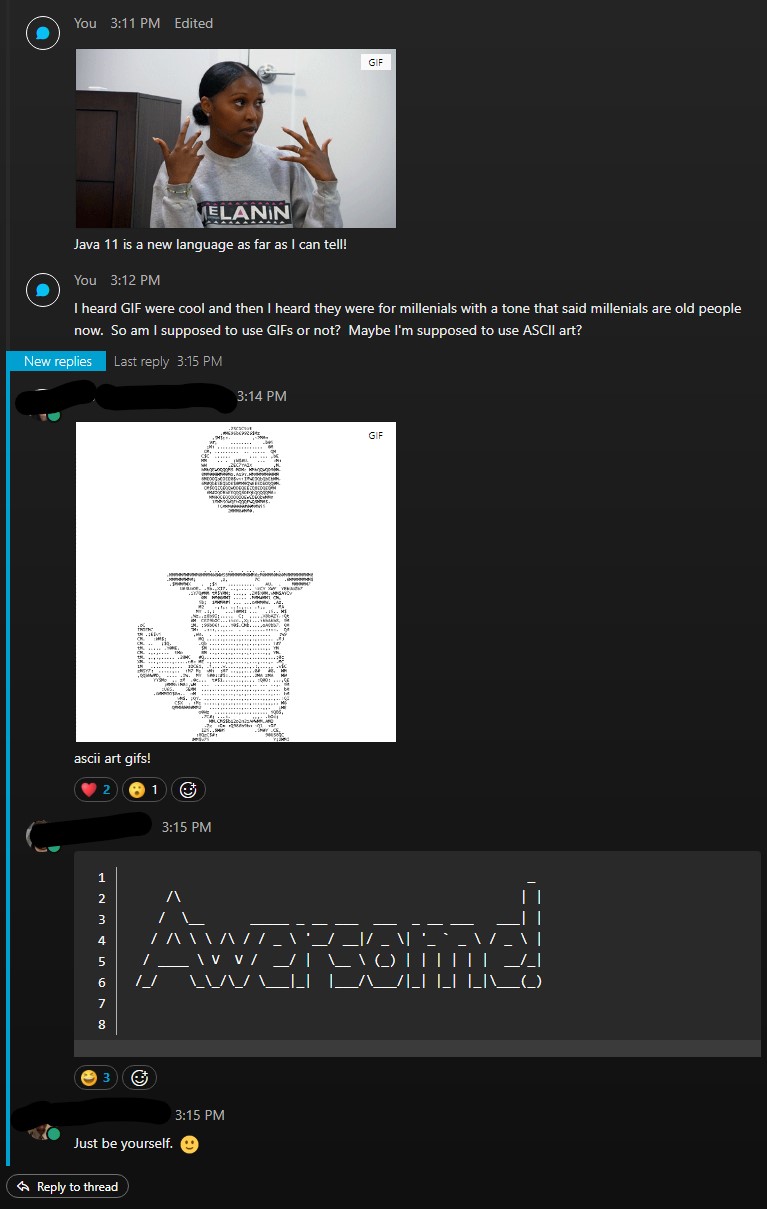
I fought using memes and emoticons in work chats as work inappropriate.  Then I decided that might be a geezer opinion and went with it, on a limited scale. I used one the other day and then asked a question about whether they were still cool.  My team totally had my back on it. ๐Ÿ‘ I heard GIFs were cool and then I heard they were for Millenials with a tone that said that Millenials are now considered old. Am I supposed to use GIF? or not? Are Millenials old?  If so compared to what? Do I have to use Generational GIFs like ASCII art๐Ÿ‘ด? Someone put up a comment that we weren't ready for a new programing language because we had enough trouble with the one are already using. I put up GIF along with a comment about how the language we were using was changing so much that it was the same thing.

The Team: Everyone gets something good to work on

Image
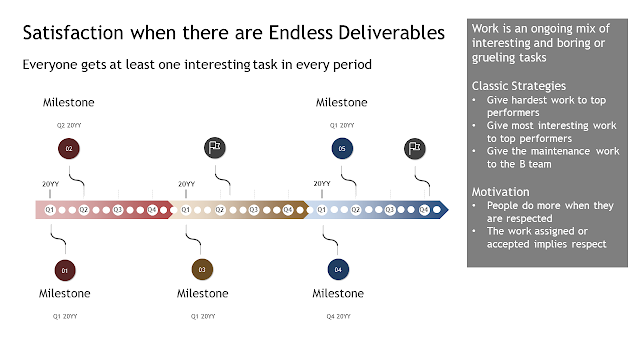
Team members are happier if we can find interesting work for everyone in every organizational period. It doesn't have to be gigantic or occupy even the bulk of the time in the period. The idea is that people feel rewarded when they get a task that implies trust in their ability or a task that is important to the team. This sounds like basic management but I've been on plenty of teams where we pigeonholed people into secondary tasks. For a Scrum software team, this may mean an interesting task in every sprint or PI. For a help desk, it may mean an interesting, off the phones, task every month. For other jobs, you tell me. Click to Expand Video Speaker Notes <to be added> Created 2022 01

Recognizing "the good old days" while you are in them

Image
I've worked for over a dozen companies across more than 20 projects.  Three team efforts stood out from the rest.  Two of the projects had  reunions or socials up to  20 years   after the project peaked . One has a Facebook group. Another has an international mailing list.  See the video below None of the projects was easy.  They all involved conflict.  All involved more than 50 hours a week at peak. Some parts were pretty miserable.  I wanted to quit and stare at the ocean.   These special projects were all personal and professional learning experiences.  They make all other employment  just work   now that I have forgotten  the exhaustion and frustration.  People go a lifetime without ever working with a group that has a reunion that draws people from hundreds of miles away. Most are shocked when I tell them I worked at  two  places where this happened.  I made friends with people I would wo...